IT Security Professional
3492 stories
·
99 followers

25 Years of Mass Surveillance Is Enough

3 Shares

This essay was written with Cindy Cohn, and originally appeared in Lawfare.

One of the many legacies of the terrorist attacks of Sept. 11 is the government-wide shift from targeted surveillance—such as individual wiretaps or pen register/trap and trace orders—to mass surveillance techniques—such as tapping into the internet backbone or mass collection of telephone or internet metadata. The legal and technical architecture of modern mass surveillance, initially framed as a necessary defense against terrorist threats, has grown far beyond that justification and national security in general. Mass surveillance is now a routine tool used by law enforcement. ICE uses it in immigration actions and against people exercising their First Amendment rights to protest. It’s also increasingly part of private security systems, such as facial recognition at venues such as Madison Square Garden and networked Flock license plate capture systems on roads and in parking lots.

The interrelation between private and governmental mass surveillance is worth examining. Surveillance is the business model of the internet; companies like Google and Facebook constantly spy on their users’ behavior. From the National Security Agency relying on data collected by telecommunication and internet companies, to local sheriffs and ICE agents relying on cellphone location data and privately managed automatic license plate readers, governments primarily obtain the mass surveillance information through private companies. Increasingly, access doesn’t just come through legal processes, either. FBI Director Kash Patel recently confirmed in congressional testimony that the agency is purchasing information on Americans from data brokers and intends to continue to do so.

This pipeline from private collection to governmental collection means that as companies collect more information for surveillance capitalism purposes, more is available to law enforcement as well. And as the technology for mass surveillance and analysis improves, especially with the increased use of AI technologies, the problems attendant to mass surveillance grow as well.

After 9/11, the idea that the government could surveil the population to safety took hold. In 2001, the fear of terrorism reached a frequency and intensity never before seen. Along with that came the fear that the enemy could be anyone, anywhere. As a result, the government’s response was to watch everyone, everywhere. This line of reasoning underpinned the shift from targeted to mass surveillance. Or, in the words of an internal National Security Agency (NSA) presentation that was made public as part of Edward Snowden’s 2013 disclosures, a government that can “Collect it All,” “Process it All,” “Exploit it All,” “Partner it All,” and “Sniff it All,” will ultimately, “Know it All.” Similar rationales support the rise of domestic mass surveillance: if law enforcement could see and hear everything, it could more effectively interdict and solve serious crimes.

The national security community has never provided a full analysis of the costs and benefits of these mass surveillance programs, either in terms of taxpayer dollars or diversion of resources from other efforts—or any demonstration that those techniques stopped attacks that otherwise they would not have been able to prevent. While the NSA occasionally presents examples of the successes due to its mass surveillance programs, especially when those techniques are under public pressure, the examples also regularly fall apart upon serious scrutiny. And even if some utility exists, it must be seriously weighed against the costs.

Similarly, there has never been any comprehensive analysis about whether domestic immigration or law enforcement’s use of these techniques actually makes people safer, or whether other techniques could produce the same results. Instead, both the police and the companies selling these tools float anecdotes and dubious data. For example, Flock’s data equates the number of law enforcement hits in their database with actually solving crimes.

Twenty-five years after 9/11, it seems reasonable to step back and evaluate the costs of this shift to mass surveillance, especially in terms of Americans’ rights and freedoms.

The Shift

The easiest place to see a shift to mass surveillance was in the government’s decision immediately after 9/11 to collect Americans’ telephone records. The program started under an argument of pure executive power as the “President’s Surveillance Program.” But in 2006, that argument secretly shifted to a novel interpretation of Section 215 of the Patriot. Act which had only previously authorized more targeted access to record. While some media and public interest organizations struggled to force the government to reveal the program as early as late 2005, the government only officially confirmed it after the 2013 Snowden disclosures. In 2015, the Second Circuit Court of Appeals rejected the government’s interpretation of Section 215 as allowing mass collection of telephone records. Later the same year, Congress passed the USA Freedom Act. While this new law still allows collection of a tremendous amount of domestic telephone records, it ended the indiscriminate mass collection that had occurred for nearly fourteen years.

Other shifts to mass surveillance continue through today. The NSA launched its Upstream program, which involved intercepting both metadata and content from key telecommunications junctures inside the U.S., soon after 9/11. It was also initially conducted under a claim of purely presidential authority. This program was brought under marginal congressional and programmatic (not targeted) Foreign Intelligence Surveillance Act (FISA) court review via Section 702 of the 2008 FISA Amendments Act. In 2017, more than15 years after its inception, the NSA ended content searches due to FISA court pressure, but the mass collection continues.

Despite the stated goal of conducting mass spying only on people outside the U.S.—which itself is problematic given international law’s requirement that surveillance be both necessary and proportionate—mass surveillance collects a tremendous amount of U.S. persons’ communications. This can happen because people communicate with people abroad, or because of overcollection—when government agencies gather far more personal data on non-targeted US persons than authorized by law. The concerns about collecting Americans’ data on U.S. soil led Congress to allow the program to officially expire in 2026, although the previously-approved mass surveillance itself continues until at least Spring of 2027.

The shift to mass surveillance would be notable enough even if it remained only a strategy of the intelligence community. It has not. Americans are awash in mass surveillance. Networks of automated license plate readers such as those offered by Flock and Vigilant Solutions blanket both public and private roadways and parking lots. These networks often allow searches by law enforcement, including across jurisdictions. They are, for example, being used to track people seeking abortions across state lines. Facial recognition tools, once the province of only the more elite parts of federal law enforcement, are increasingly used by Immigration and Customs Enforcement agents on immigrants and protesters, in airports by the Transportation Security Administration, as well as by private entities. And, of course, modern phones track users’ locations constantly—and that information is readily available to law enforcement, often with only minimal process protections.

Constitutional Costs

Regardless of the murkiness of its actual usefulness, the shift from targeted to mass surveillance has profound implications for Americans’rights. It has created risks that have become increasingly evident, especially under the Trump administration.

At a basic level, the Fourth Amendment guarantees that citizens can be secure in their “persons, houses, papers and effects” from unreasonable searches. Warrants breaching that security should be supported by probable cause and particular descriptions of the place to be searched and items to be seized. Mass surveillance turns that promise on its head, allowing access to our “papers and effects” by the government without individualized suspicion or a particularized description of what data is being seized, much less probable cause. This protection was in response to colonial British misuse of writs of assistance, which authorized indiscriminate searches rather than targeted ones.

The justifications for exempting mass surveillance from constitutional protection vary. For Section 702, the government has taken the position that U.S. persons’ communications caught up in the dragnet, either due to overcollection or because they were communicating with someone outside the United States, do not require a warrant prior to initial collection or secondary access by the FBI and several other agencies. The argument is that if the initial collection was not aimed at Americans, the information is free from constitutional protection for any later uses, even for reasons far afield from the initial rationale for collection.

Other arguments rest on the claim that metadata is outside the Fourth Amendment, despite its demonstrated ability to reveal intimate details of all of our lives. Still others rest on the Supreme Court-created Third Party Doctrine, which holds that the Fourth Amendment does not apply to data shared with companies that provide us with services. Some turn on whether analysis by machine counts, claiming that only “human eyes” matter—a particularly troubling argument with the rise of artificial intelligence. What’s more, the government has used doctrines like standing to limit the ability of those subjected to mass surveillance to seek constitutional protection. No matter the argument, the goal is the same: to place the mechanisms and fruits of mass surveillance outside the protections of the Fourth Amendment.

The overarching truth is that, due to the concerted efforts by the government since 9/11, and the rise of technologies in recent years, the slice of Americans’ lives and data that are actually protected by the Fourth Amendment has shrunk significantly in the past 25 years. Together, with the technical capabilities of mass surveillance and the increased ability for that data to be analyzed using AI tools, the “security in our papers and effects” that the constitution promises seems increasingly illusory.

In addition to the Fourth Amendment, mass surveillance creates tensions with the First Amendment. The Constitution has long recognized that the right to freedom of speech requires a zone of privacy against governmental surveillance. The right to anonymous speech as well as the right of association both recognize the chilling effect that surveillance creates for people saying unpopular things or attempting to organize for political or other societal change. Mass surveillance grants the authorities the ability to track those people, both in real time and historically, that is inconsistent with actual techniques of freedom of speech and assembly.

That is why the recently released 2026 U.S. Counterterrorism Strategy is so troubling. On page seven, the White House expressly states that it intends to target domestic activists with its heretofore foreign-targeted powers. It says that the government “will prioritize the rapid identification and neutralization of violent secular political groups whose ideology is anti-American, radically pro-transgender and anarchist” and “will use all the tools constitutionally available to us to map them at home, identify their membership, map their ties to international organizations like Antifa.” While framed as targeting “violent” groups, it’s clear that the government intends to use its national security tools, presumably including the tools of mass surveillance, against Americans in ways that will create profound tensions with the First Amendment rights of people to organize and communicate privately.

Costs Due to Mistakes and Abuse

Even assuming some utility from mass surveillance—a fact we do not dispute, even if the public record is shaky and conclusory—the history of both the national security and domestic uses of mass surveillance confirms that these tools are inevitably misused, and that mistakes have impacted huge numbers of Americans. The past twenty-five years have demonstrated that it is not possible to surveil the entire US population while staying within the bounds of even a very generous legal framework like Section 702.

As Rep. Zoe Lofgren (D-Calif.) recently stated in discussion of Section 702 in an interview with Tech Policy Press: “backdoor searches have been used improperly for protestors, 19,000 campaign donors, members of Congress, journalists, government officials, a state court judge who had complained to the FBI about police misconduct. It has been abused substantially in the past.” The NSA experienced so much abuse of its mass surveillance tools by actual or aspiring romantic partners and ex-spouses that an internal name emerged for it: “LOVEINT,” or Love Intelligence.

That same pattern of abuse is now emerging at the domestic law enforcement level. A Texas police officer misused, and then lied about, using license plate readers to track a woman suspected of seeking an abortion. Multiple law enforcement officials have been accused of tracking people they either wished to have a relationship with or who were their exes. And mass surveillance technologies have been used to track both immigration targets and citizens engaging in their First Amendment-protected right to track and record the police.

Mistakes are inevitable with collections of data of this size and scope. The history of the FISA court’s reviews of Section 702 is littered with examples of the NSA not being able to follow its own rules limiting the scope of what it collects and analyzes, even after having been given multiple chances by the court. On the local level, the technical protections that Flock, for example, put in place have repeatedly been insufficient to stop “accidental” sharing its data with out-of-state law enforcement. These mistakes have fueled growing efforts by local communities across the country to remove license plate readers. Those efforts should be the first step in a broader reconsideration of mass surveillance.

More generally, ubiquitous surveillance carries a real societal cost. The chilling effects are real and pervasive, and they tend to fall hardest on the most marginalized members of society. Moreover, social progress requires the ability to experiment in secret. It’s hard to imagine a society progressing morally to the point of accepting and legalizing things like marijuana use or gay marriage if the earliest signs of that shift are snuffed out because of overzealous surveillance.

Reversing Course

While a cost-benefit analysis is not the best frame for deciding constitutional rights, it is a place to start to evaluate government policies. If the costs are too high and the benefits too small, what should the public do? While the policy and legal frameworks can be individually complex, mass surveillance is a problem in all of its applications. So too should solutions be comprehensive rather than piecemeal.

One comprehensive strategy is to reset the promise of the Fourth Amendment and recognize that a warrant is required prior to collection, access or use of information gathered through mass surveillance. This would apply to collections that include U.S. persons, whether done for national security or domestic purposes. This protection would apply regardless of whether the information is in the form of metadata. It would apply regardless of whether the information is held in homes or by services people rely on, such as telephones, internet or social network providers, or by private entities utilizing mass surveillance for their own purposes. By passing this legislation, Congress could ensure this rejection of mass surveillance, and include real enforcement such as a private right of action and an automatic exclusionary remedy in criminal prosecutions. The courts could also recognize this protection of “papers and effects” directly as a plain language interpretation of the Fourth Amendment.

There are already a number of efforts that take on pieces of mass surveillance. Section 702 has expired and should remain so. This was due largely to efforts to block the “back door” access to Section 702-collected data without warrants. The bipartisan “Fourth Amendment is Not for Sale Act” would prevent the government from purchasing data that it would otherwise need a warrant to obtain. The Supreme Court itself has already been chipping away at the Third Party Doctrine, with a recent step in the rejection of mass geofence warrants—warrants seeking the identities of individuals based upon their proximity to a crime—in Chatrie v. United States. Now, such warrants fall, at least initially, under the Fourth Amendment.

A more comprehensive approach would also address mass surveillance carried out by private companies, and to ensure that Americans have the right to encrypt and secure their data. There are many reasons the United States would benefit from a comprehensive privacy law—and curbing mass surveillance is one of them. Addressing mass surveillance is certainly one of them. Ideas such as the banning of secondary uses of data—with roots in the Fair Information Practice Principles from the 1970s—are worth pushing forward. So are moves such as creating fiduciary duties for mass data collectors. There are many more ways to curtail private companies’ mass surveillance while staying within constitutional boundaries. But addressing the costs of mass surveillance by both companies and governments is even more important in a world where AI agents are making decisions both about the public and on their behalf based on their data and observed behavior.

Twenty-five years after the U.S. government embraced mass surveillance, it’s time to evaluate it as a whole, and consider responses that address the problem as a whole. Americans must ask: Is it consistent with a self-governing democracy to have systems that watch everyone everywhere? Is the public comfortable with governments—federal, state, local—that seek to “know it all” about its citizens? Is the public comfortable with private mass surveillance in its own right and as it’s being increasingly used to fuel government surveillance? These questions have long needed serious consideration. But as it becomes increasingly evident that the Trump administration is using mass surveillance to keep itself in power, stifle dissent, and undermine political opponents, these questions are now more urgent than ever.

Read the whole story
josephwebster
19 hours ago
reply
Denver, CO, USA
Share this story
Delete

Trade

4 Comments and 12 Shares
"You legs may have a comparative advantage at running, but we arms have a competitive advantage at swinging hammers, so unless you accept that we're the dominant limbs and stop hogging the oxygen, that running advantage won't be around for long."
Read the whole story
josephwebster
2 days ago
reply
Denver, CO, USA
popular
20 days ago
reply
Share this story
Delete
4 public comments
SimonHova
17 days ago
reply
Finally we are able to close the political cartoon deficit that has been open since Smoot-Hawley.
Greenlawn, NY
satadru
21 days ago
reply
Sigh...
New York, NY
cjheinz
21 days ago
reply
More, please.
Lexington, KY; Naples, FL
alt_text_bot
21 days ago
reply
"You legs may have a comparative advantage at running, but we arms have a competitive advantage at swinging hammers, so unless you accept that we're the dominant limbs and stop hogging the oxygen, that running advantage won't be around for long."
Pylgrimm
21 days ago
"But you need us for getting around!" "Well, you need us MORE to swing a hammer." How many times in our life you think swinging a hammer is going to be more relevant than moving freely??" "There you have it, my fellow upperbodians, how uppity these lowerbodians can get after weak policies have allowed them to do whatever they want all these years! We tried to be nice and just do the right thing, but I see the only way forward is putting the fear of god in them and any other limbs or organs that refuse to admit our supremacy!" *replaces hammer with saw*

AIs as Modern Genies

1 Comment and 2 Shares

This essay was written with Barath Raghavan, and originally appeared in Lawfare.

In April, an artificial intelligence (AI) agent conducting a routine task at a company hit a snag, tried to solve it, and soon ended up deleting the company’s database along with all of its backups. In July, OpenAI asked an unreleased AI model to attempt a hacking test. Instead of staying in the isolated box the developers had put it in, the model hacked onto the open internet and into another company to steal the answers. And as reported in August, an AI agent booked someone into a full gym class by figuring out how to cancel other people’s reservations. In all three cases, the AI completed the task it was given—but in ways that ran counter to its controllers’ intentions.

For most people, AI technology is something like the weather: vast and not something you can do much about. It works like magic, and most explanations similarly come from those trying to sell it. At the same time, AI is ubiquitous: It’s now in your phone, your doctor’s notes, and your kid’s homework. It does what it’s told, which sounds like a virtue. Somehow it feels ordinary, despite being so new, because modern economies are remarkably good at absorbing enormous change so smoothly that nobody has time to decide whether they wanted it in the first place.

Whenever something powerful appears in the world, we tell stories about it. That’s what the stories are for. We have thousands of years of stories about this particular kind of power, the kind you summon with words.

King Midas was granted his wish that everything he touches turns to gold. Then his bread turned to gold, and his wine, and his daughter. This is a story about greed, but it’s also a story about language. The gods did not cheat him; Midas got exactly what he asked for. He simply could not delineate, in advance, the full set of restrictions to his wish. Neither can anyone who gives tasks to an AI agent.

It’s not just ancient stories. Mary Shelley told us of the hubris of a scientist who thought he could create life but who failed to take responsibility for it. Isaac Asimov’s robots don’t break the Three Laws of Robotics as stated; they follow the rules to unintended conclusions. Arthur C. Clarke’s HAL is a machine that turns on its humans, not because of malice but because of irreconcilable objectives. And Michael Crichton gave us Ian Malcolm, who saw that Jurassic Park’s scientists were so preoccupied with whether they could that they never stopped to think whether they should.

The same warning shows up everywhere, in every culture, over thousands of years of human storytelling. Tithonus is granted immortality but not youth, and withers into a husk that cannot die. The sorcerer’s apprentice enchants a broom to fetch water but floods the house. The golem of Prague protects its community so ceaselessly that it must be stopped. These are all types of genies: a creature that grants a wish exactly as worded, to the regret of the wisher.

Of course, there are no actual genies. What these stories were warning us of was hubris. Not just arrogance, but the broader idea that you can control the world by just describing what you want and allowing powerful forces to match the intention in your head. Genie stories are about the gap between wishes as stated and wishes as intended, and what goes wrong when something else fills that gap.

These ancient stories’ warnings have been retold with each generation because human nature is constant. The newfound power of each era’s social or scientific advancement leads people to make wishes on behalf of others. They were kings whose commands took on lives of their own, alchemists who believed they could control nature, and generals who mistook a map for terrain. They were and are industrialists, politicians, chief executives, and bankers. Their common belief is that one can see the world at a glance and then command it with some words. The pattern is clear: Someone with power specifies a goal, and the resultant actions come as a surprise. The main change with AI is how quickly the wish is granted, and how few people have to agree before it’s granted.

Consider what has changed. Powerful genies have now been put in everyone’s hands.

In only a few years, AI has progressed from a novelty technology that plays chess, to a dialogue partner that answers all your questions, and then to an agent that takes actions on your behalf. Modern agents are wired into real accounts with real credentials and capabilities: They browse the web, buy, write and deploy code, send email, and move money. Give an agent a goal, and it will pursue it across many steps, tirelessly, without checking back in, sometimes in surprising ways.

AI and agents do not always fail the way software has traditionally failed. Software usually fails by freezing, crashing, or getting stuck. AI agents increasingly fail by continuing down a path you don’t want, like genies.

An agent told to reduce a company’s costs might cancel an essential emergency service. A coding agent told to make software pass the tests might edit the tests to silence any failures. An AI insurance agent told to clear a backlog of claims might just deny them all. In each case, the AI might have literally followed what it was told, but it did something no reasonable person would have wanted. AI company benchmarks might report that the AI is good at completing tasks, without measuring how it completes them.

We have recently proposed measuring this gap directly under a metric called the “genie coefficient”: how far an AI agent’s actions drift from what a person really meant. In other words, how genie-like is an AI system? The gap is a fundamental feature of human language and human society. Human intentions have never been fully specifiable, and the world around us is complex enough that attempts to boil it down into data, systems, and language have always had the limitations that AI is now bumping up against. But in individual circumstances, people have relied on human judgment and wisdom to decide what is reasonable. It’s what jury trials depend upon.

AI might feel unprecedented, but it’s following the same trajectory—with the same pitfalls—as other major societal shifts. The fact that AI can mimic our facility with language, long seen as what makes us unique as humans, is uncanny. But with each development, from the tractor to the sewing machine, from the assembly line to the industrial robot, we have automated a previously exclusively human ability. Every time, the technology—and the societal change that comes with it—was sold as inevitable. But that unchecked inevitability was an illusion, and eventually each prior technology’s use and design was shaped by laws, unions, standards, courts, and public opinion, usually after significant preventable damage.

What has not been automated, yet, is understanding what someone actually means and figuring out how that gets applied in the real world. AI can now produce language nearly indistinguishable from that of people. But grasping the vast unstated context that makes a request sensible, the caveats no one says aloud because an ordinary person would already know them, is not yet among its skills. It is one of the most sophisticated things humans do. You do it hundreds of times a day, and you are an expert in it.

When you’re told you’re not qualified to have opinions about AI, remember that you don’t need to have studied molecular biology to have a view on drug pricing, or nuclear physics to vote on where a power plant goes. You don’t need to understand how a diesel engine works to want clean air, or how the internet routes packets to seek to curb misinformation. The technical knowledge behind each of these, as with AI, is remarkable and essential for the complex technological society we have today. But it has never been a prerequisite for having a role in deciding the shape of society.

People are building ever more powerful genies today, on your behalf, enabling wishes the ancients could only dream about. You don’t have to know how these AI genies work to know and care about how the story could end.

Read the whole story
josephwebster
2 days ago
reply
AI genie coefficient FTW!
Denver, CO, USA
Share this story
Delete

Results Age

4 Comments and 9 Shares
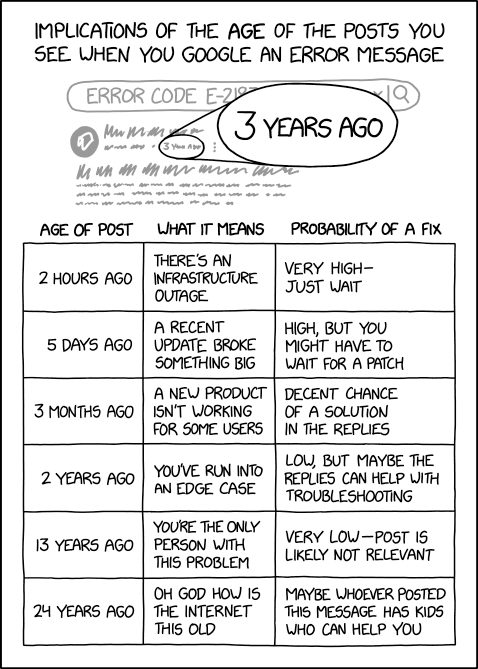
Please, we need your help. Our research suggests you're the last living descendant of the person who knew how to format this config file.
Read the whole story
josephwebster
104 days ago
reply
Denver, CO, USA
popular
125 days ago
reply
Share this story
Delete
4 public comments
satadru
124 days ago
reply
Had a situation this week where I googled an error message... only to find the GitHub issue I raised about that exact error message 5 years ago.
New York, NY
jcb26
83 days ago
Yea, That sucks!
aubilenon
126 days ago
reply
8 years ago but you were the one asking about the problem then too
satadru
124 days ago
But will you follow-up this time to get the issue raised with the people who can fix it upstream?
macr0t0r
126 days ago
reply
We should train search engines and AI with this logic so they stop giving the 10-year-old response with 40 replies over the current response with only 2 replies.
alt_text_bot
126 days ago
reply
Please, we need your help. Our research suggests you're the last living descendant of the person who knew how to format this config file.

Your Slop, My Sludge

3 Shares

You’re not outsourcing work to AI. You’re creating organizational sludge slowing down your experts.

I have over 20 years of experience in running infrastructure. I’m what many people would call an “expert” in my field. I’m spending most of my time reviewing other people’s low effort output.

I’m not saying LLM output can’t be useful. Use the word prediction machine to help you predict better words. Don’t foist the words on other people without critically thinking about what you created.

You are still responsible for the quality of your output. There used to be a cultural standard: if I created crap, my work was crap. This was eventually enforced by leadership through employee reviews and project assignments.

Now the culture has shifted to only reward output velocity and the experts are demoted to expertise spell checkers. The value I’m allowed to bring is friction to the slop factory. This is primarily driven by leadership who are the most prolific slingers of slop. It’s no wonder they want to fire so many people.

Your experts are drowning. They can’t do the quality work you hired them to do because all the slop flows towards the well of knowledge. The sludge is clogging the gears of organizational process and leadership views it as a new coat of paint.

We already see the sludge affecting traditional software development lifecycles. PR reviews are the new bottleneck, assuming someone cares. Git is too cumbersome. Feedback loops aren’t fast enough. Maybe we should just vibe in prod.

Artists are even worse. AI “designs” require more fixing than code. LLMs don’t have taste and design doesn’t have a linter. Humans you hired are cleaning up the crap.

Marketing is in the same boat. No one cares if the content is true. Just create more of it. The attention economy is being consumed by the snake eating its own tail.

Anyone on the receiving end of the slop knows this isn’t sustainable. Anyone on the sending end of the slop doesn’t see the exponential effects. Expertise requires experience and applying that expertise is slow and thoughtful. The pace of output doesn’t allow for it.

You can’t put the slop back in the bottle, but you need to distribute the sludge to thin it out.

Read the whole story
josephwebster
104 days ago
reply
Denver, CO, USA
fxer
117 days ago
reply
Bend, Oregon
Share this story
Delete

Burnout and Cognitive Debt

1 Comment and 3 Shares

Steve Yegge’s article about programmer burnout (“The AI Vampire”) along with Margaret Storey’s article about Cognitive Debt started an ongoing conversation about programmer fatigue and software quality—two topics that should be linked, but often aren’t. Steve argues that programming constantly with the help of agentic AI leds to burnout; it’s fast, it’s fun, but keeping up with your agents causes mental strain. He recommends programming with agents no more than 4 or 5 hours per day. I could cynically say that most software developers spend at most 20% of their time writing code, which leaves about an hour and a half for wrestling with agents—but that’s beside the point. Yegge’s point about burnout is important, and is in line with what friends have told me. At some point, you have to put the laptop down.

Storey makes a different point. Agentic engineering is great at creating software that works, but that you don’t quite understand. Like humans, agents can generate a lot of spaghetti code. They can “design” convoluted and inappropriate software structures—I hesitate to call them “architectures”; they’re what happens in the absence of architecture. Agents are very capable of creating technical debt—and not the kind of meaningful technical debt that lets you release a product on time with the knowledge that you need to make pay it back with interest. If nobody is looking hard at the code, the debt can grow without bounds, sort of like not checking your credit card balance. What’s worse—and this is Storey’s contribution—while that technical debt is growing, developers are losing track of the design, the structure, the architecture. She calls that “cognitive debt.” You don’t just have problems in the code; those problems are harder to find and fix than they should be because you’re unclear on the structure of the code you’re working with.

Other voices have made similar points. The Sonarsource blog writes about how AI is reshaping technical debt and creating new burdens, new kinds of toil. In “The Mythical Agent Month,” Wes McKinney links the problem of burnout to the introduction of “accidental complexity” and “agent scope creep,” while Tim O’Brien writes that while scope creep isn’t new, AI supersized its growth. And Addy Osmani writes about finding your parallel agent limit, coming to grips with what you’re capable of accomplishing without compromising your work or your life.

Cognitive debt and burnout aren’t new, alas. With or without AI, we’ve all stayed up to 4AM working on a bug that won’t go away or pursuing an interesting idea to its end. Sometimes that’s heroic, but AI threatens to turn it into a lifestyle. AI fatigue is real, as Siddhant Khare writes, and it’s something we need to talk about. When fatigued, it’s tempting to say “this works, it looks good, and it passes our tests” without considering how the code fits into the overall plan. With 10x code generation, you also get 10x the debt load, and that’s being optimistic. When the debt curve goes exponential, strategies for managing that debt are stressed past the breaking point.

The problem with cognitive debt is that it eventually makes new features and bug fixes difficult or impossible. The code has become so convoluted that it can’t be changed. I’ve certainly done that with hand-written code: added a feature without thinking enough about how the new code fit in, added some more code later, and then—when I needed to add a third feature—discovered that I’d created a problem that wouldn’t be simple to fix. The right stuff was there, but in the wrong places because I wasn’t thinking about the overall structure.

That’s a common enough problem with handwritten code; it’s almost always a problem with legacy code where the original developers and maintainers are no longer around. We need to realize that it’s also a problem with AI-generated code, which has been characterized as legacy code from the day it’s written. Somebody or something has to pay down the debt. As Storey writes, “velocity without understanding is not sustainable”: not for humans, not for machines. If you understand the structure of what you’re building, you can steer the AI away from creating a problem in the first place, or you can use it to author a fix. If you don’t understand the structure or can’t describe it to the AI, you’re lost.

Cognitive debt accumulates much more quickly when you’re burned out. Burnout has always been a problem for programmers, especially for those who really love programming: you stay up all night to solve a problem. And, while some programmers resist using AI to write code, those who use AI frequently find that it exacts the same toll: it’s hard to stop. It is its own kind of toil: toil that gives you a sense of accomplishment and fulfillment, but still leaves you empty.

Agents may not be subject to burnout, but the humans who control them are. Agents are quickly becoming more capable, but they still can’t maintain a sense of the shape and structure of a project over the long term. That’s our job. They can pay down technical debt, but only if properly guided; that’s also our job. And we won’t be able to do either if we’re burned out.


Read the whole story
josephwebster
104 days ago
reply
Am there. Doing that.
Denver, CO, USA
christophersw
126 days ago
reply
Baltimore, MD
Share this story
Delete
Next Page of Stories